
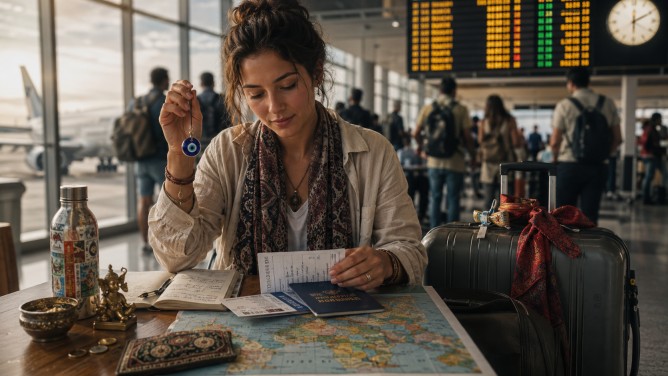
The allure of travel often lies in the traditions and rituals that accompany it, adding layers of cultural richness and personal significance to each journey. Across the globe, various superstitions have emerged, believed to bring good fortune or protection to travellers. These beliefs, while diverse, share a common goal: ensuring a safe and successful trip.
In parts of the Balkans, carrying a clove of garlic in one’s luggage is thought to ward off negative energy and the evil eye, offering a protective charm for those on the move. Meanwhile, a common practice among flyers is to touch the outside of an aircraft before boarding. This small gesture is said to bring good luck and provides comfort to those who may be anxious about flying. Similarly, some travellers adhere to the practice of stepping onto a plane with their right foot first, a nod to the idiom of starting “on the right foot,” symbolizing a positive beginning to their journey.
Cultural rituals also extend beyond the individual to involve family and community. In parts of the Middle East and the Balkans, it is customary for families to pour or sprinkle water behind someone setting off on a trip. The flowing water symbolizes a smooth and safe journey, with hopes for the traveller’s safe return. Additionally, in Slavic cultures, there is a tradition of sitting on packed luggage briefly before departing. This pause allows for a moment of reflection and mental preparation before embarking on a trip.
Numbers also play a significant role in travel superstitions. In many Western countries, the number 13 is considered unlucky, while in China, the number 4 is often avoided due to its phonetic similarity to the word for death. Italy has its own unlucky number: 17. These beliefs can influence various aspects of travel, from hotel room assignments to building floor numbers. In several cultures, sweeping the floor immediately after a traveller leaves is discouraged, as it is believed to sweep away their good fortune and potentially disrupt their safe return.
While these travel superstitions may lack scientific grounding, they persist as intriguing elements of cultural heritage and personal tradition. For many, these rituals are not just about their effectiveness but are cherished practices that preserve family customs and enhance the excitement of embarking on a new adventure.