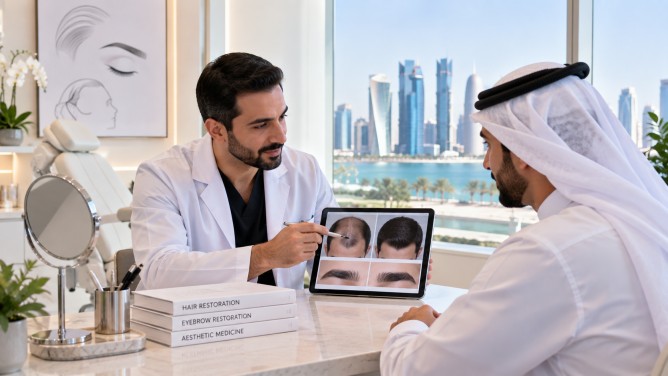
In Qatar, Padra has unveiled a pioneering patient-care framework specifically tailored for hair and eyebrow restoration services. Emphasizing privacy, informed choices, personalized treatment strategies, and achieving natural results, this new approach is set to revolutionize patient experiences. The framework is meticulously designed to escort patients from the initial consultation through to individual assessments, consent, treatment planning, recovery, and follow-up, ensuring that patients maintain significant control over their treatment journey.
Padra’s method goes beyond merely achieving cosmetic outcomes; it incorporates considerations such as medical suitability, facial features, hair type, lifestyle, personal expectations, privacy preferences, and tolerance for visible recovery. For those contemplating hair transplants in Qatar, the planning process involves evaluating hair loss patterns, donor-area quality, and facial proportions. Utilizing FUE-based transplantation, Padra customizes decisions regarding hairline placement, graft distribution, and follicular direction to suit each patient. The company emphasizes that treatment planning should not necessarily aim for the lowest hairline or the maximum number of grafts but should instead consider donor limitations, long-term appearance, and facial harmony.
When it comes to eyebrow restoration, different design considerations come into play. Small alterations in hair direction, density, and shape can significantly impact facial expressions. Patients seeking eyebrow transplants are assessed based on their current eyebrow structure, facial proportions, natural asymmetry, donor-hair characteristics, and desired appearance. The Nano Transplant Fakhraei (NTF) technique is employed, focusing on individual follicular selection, precise hair-by-hair placement, and patient-specific brow mapping, with attention to the growth patterns of the inner brow, arch, and tail.
Privacy is a cornerstone of Padra’s consultation and treatment process. Patients have the opportunity to specify their preferences regarding appointment communications, clinical photography, documentation, and the involvement of family members. Consent for clinical documentation is distinct from the permission required for using photographs or treatment information for promotional purposes. Furthermore, while partners or family members can be involved in treatment discussions, the patient retains control over who participates and receives information.
Recovery planning is another critical component of this framework. Patients receive detailed information about potential temporary effects such as redness, swelling, and donor-area visibility, as well as guidance on activity restrictions, early shedding, grooming, and recovery timelines. The distinction between medical recovery and social downtime is highlighted, acknowledging that patients may be ready to resume normal activities while preferring to avoid situations where temporary treatment effects might be noticeable. Scheduling can be personalized to accommodate work, travel, family events, and other personal considerations. Padra stresses that individual outcomes can vary based on numerous factors, including donor quality, hair characteristics, and adherence to aftercare instructions, and that restoration procedures should not be depicted as guaranteed transformations. Follow-up support is provided to guide patients through aftercare, washing, grooming, and expected hair growth stages, with additional professional assessments available as needed. This framework is presented as a patient-experience model, focusing on privacy, personalized planning, and realistic expectations throughout the restoration process.
Legal Disclaimer:
The information contained in this article has been provided by independent third-party contributors, clients, or content partners. We do not independently verify the accuracy, completeness, legality, ownership, licensing, or reliability of submitted content, including text, images, videos, trademarks, or other media materials. The submitting party is solely responsible for ensuring that all content, including images and media assets, complies with applicable copyright, trademark, licensing, and intellectual property laws. We disclaim liability for any unauthorized use of copyrighted or proprietary materials by third parties. If you believe that any content published on this platform infringes your intellectual property rights, kindly contact the author above for prompt review and resolution.